Assessing United Nations’ Integrated Indicators Solutions Within the Context of the Millennium Development Goals
New information technologies (IT) are available through various UN agencies facilitating access and interpretation of more accurate and timely data. This development is, in part, the result of a widely recognized need around the world and within the UN community to collect, inventory and facilitate access to information through information systems, in particular to indicator systems as a key tool for decision making and for monitoring and evaluation activities. Examples of such developments are DevInfo 4.0 (UNICEF/Community System Foundation)3 and R+SP (UN-ECLAC-Population Division).
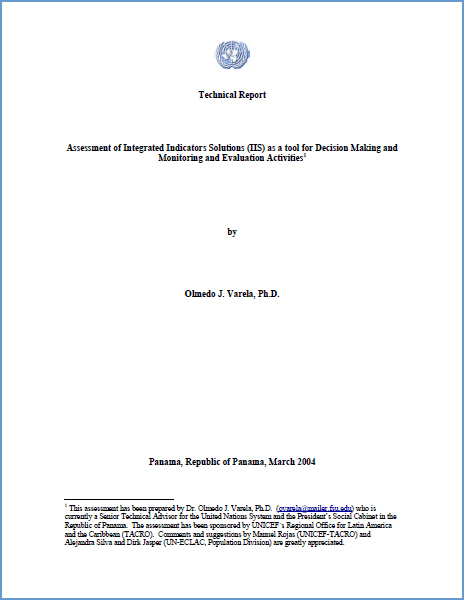
The assessment suggest that IIS will benefit from metadata-driven indicators that ensure fitness for use, minimizing uncertainty through fully documented according to agreed-upon definitions and standards, maximizing data usefulness, and promoting proper usage of indicators within a dynamically integrated and conceptually founded environment. This should help prevent the frequent undesirable practice of using and interpreting indicators, within the context of measuring progress toward goals and objectives, without a definition of the concepts involved; without a rationale of the causal relationship between goals and objectives, including their conceptual, methodological and evidence-based justification; and without a methodological statement regarding the indicators´ validity and reliability.